Storage you operate
Application messages and structured records live in your company-managed SQL database. Shared files live on the server. Employee clients use the application rather than directly accessing the database. Customer IT manages storage, backups and retention.
This can reduce reliance on personal accounts and unmanaged external sharing for work performed in Multiple. It does not prevent an authorised employee from downloading, copying, photographing or sharing information elsewhere. Protect downloaded files, endpoints and backup copies too.
Access that can change with employment
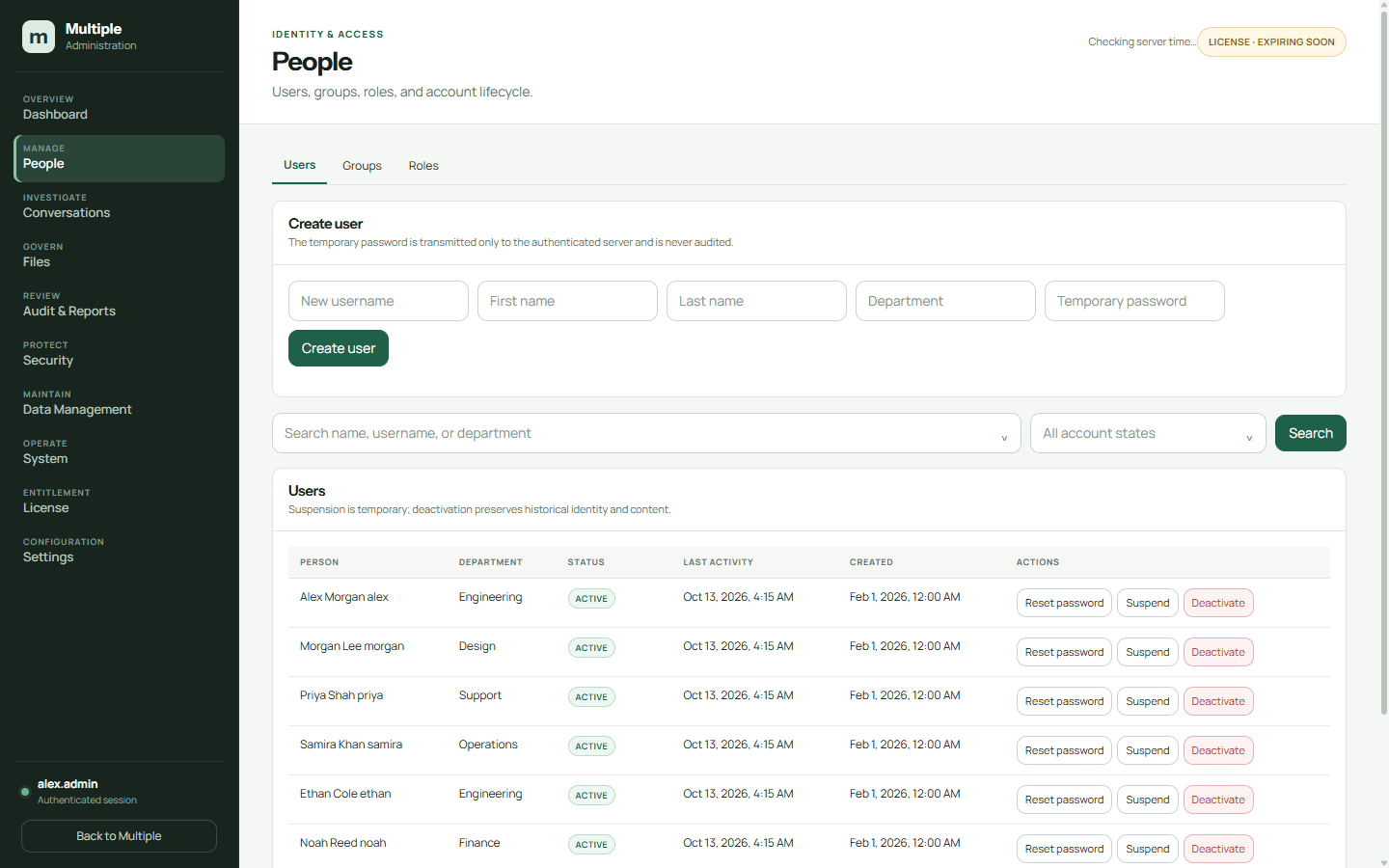
Authorised administrators can suspend or deactivate accounts and revoke sessions. Conversation membership and authorised downloads are checked on the server. Administrative permissions separate access to sensitive operations.
Offboarding remains an IT process: the application does not automatically integrate with HR or erase copies already saved outside it. Establish who approves access, who acts when a person leaves and how those actions are reviewed.
Trusted connections and controlled reviews
The documented production connection uses HTTPS/WSS with certificate verification. This protects the application transport; end-to-end message encryption is not claimed. TLS trust, private keys and certificate renewal need proper administration.
Audit records support review of relevant account and administrator activity. Permission-controlled investigations, protected searches, views and exports require reasons and references. These are investigation controls, not a claim of automatic threat detection or complete forensic coverage.
Choose shared-file access individually
Basic shared documents, sheets and code files have separate View, Edit and Download grants for each person. Group-admin status does not automatically grant those rights.
The AI summary control is removed from the current beta and is not offered as a working feature. Core messaging and basic shared editing do not depend on an AI endpoint.
What a buyer should verify
Secure employee devices, least-privilege accounts, configured network access, trusted certificates, updates and tested backups all remain necessary. A private deployment can still be affected by insider misuse, compromised clients, configuration errors or operational failures.
No independent compliance certification, air-gap certification, quantified breach reduction or unlimited capacity is claimed. Production acceptance and independent security review remain distinct from implemented controls and source-level tests. Review the proposed release and outstanding gates before rollout.
Common questions
Is “no public internet” the same as secure?
No. It removes a core connectivity dependency and lets IT avoid public application exposure, but local devices, accounts and services still need protection.
Does the website access our employees’ messages?
No. This marketing website and its hosted enquiry database are separate from a customer’s Multiple deployment. The demo form does not connect to employee messages or files.